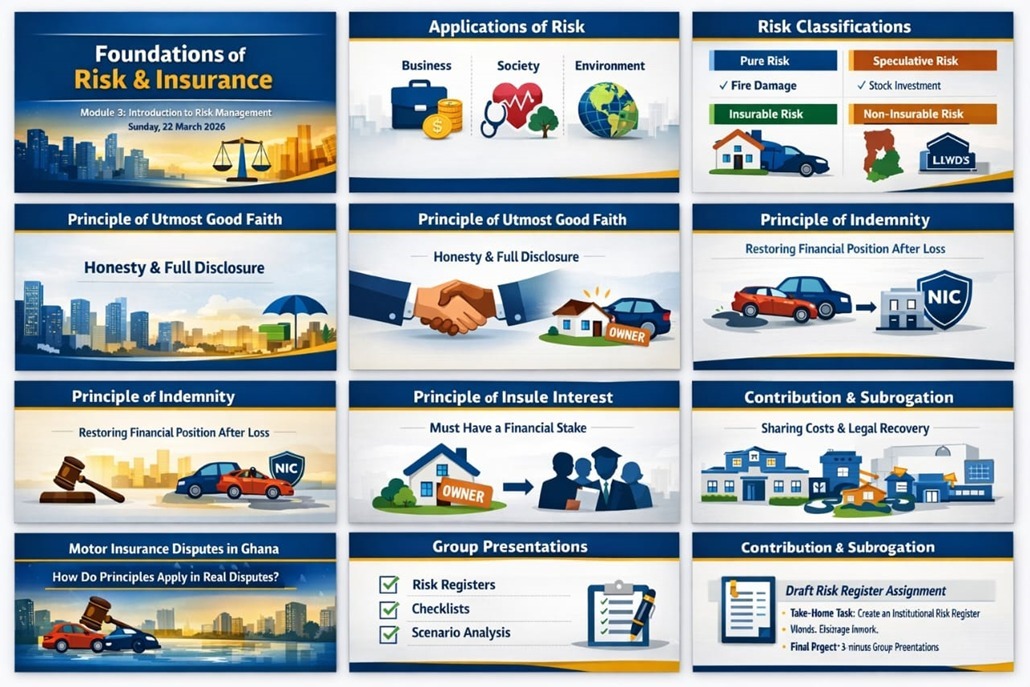
Definition of Risk: Risk is the possibility of an adverse outcome due to uncertainty. It can be classified into:
- Pure risk: Only loss or no loss (e.g., fire, theft, illness).
- Speculative risk: Potential for loss or gain (e.g., investments, entrepreneurship).
Types of Risk
- Financial risk: Market volatility, credit defaults.
- Operational risk: Failures in processes, systems, or human error.
- Strategic risk: Poor business decisions or external shocks.
- Compliance/legal risk: Regulatory breaches, lawsuits.
- Environmental/social risk: Natural disasters, reputational damage.
Risk Management Process
- Identification – spotting exposures.
- Assessment – measuring probability and impact.
- Control – prevention and mitigation strategies.
- Financing – transferring risk via insurance or hedging.
- Monitoring – continuous review and adaptation.
Foundations of Insurance
Definition of Insurance
Insurance is a contractual arrangement where risk is transferred from an individual or firm to an insurer in exchange for a premium.
Core Principles
- Pooling of risk: Losses are shared among many policyholders.
- Law of large numbers: Predictability improves with larger insured groups.
- Indemnity: Compensation restores the insured to their pre-loss position.
- Utmost good faith: Both parties must disclose material facts honestly.
- Insurable interest: The insured must stand to suffer a genuine loss.
- Subrogation: Insurer assumes the insured’s legal rights after compensation.
Types of Insurance
- Life insurance: Covers mortality and longevity risks.
- Health insurance: Protects against medical expenses.
- Property insurance: Safeguards physical assets.
- Liability insurance: Covers legal obligations to third parties.
- Reinsurance: Insurers transfer part of their risk to other insurers.
Academic and Professional Relevance
Economic Role: Insurance stabilizes households and firms, enabling sustainable livelihoods despite uncertainty.
Institutional Role: Risk management enhances governance, compliance, and resilience in financial institutions.
Global Context: Postgraduate students must understand how insurance markets interact with international finance, regulation, and development.
Analytical Skills: Quantitative methods (probability, statistics, actuarial science) underpin risk assessment and insurance pricing.
Comparison Table: Risk vs. Insurance Foundations
|
Aspect |
Risk |
Insurance |
|
Nature |
Uncertainty with potential loss
|
Contractual transfer of risk |
|
Classification |
Pure, speculative, financial, etc. |
Life, health, property, liability |
|
Management Approach |
Identify, assess, control, finance |
Pooling, indemnity, subrogation |
|
Key Principle |
Probability & impact analysis |
Utmost good faith, insurable interest |
|
Outcome |
Mitigation or avoidance |
Compensation and stability |
Challenges & Considerations
Moral hazard: Insured parties may act less cautiously.
Adverse selection: High-risk individuals disproportionately seek insurance.
Regulatory compliance: Insurers must meet solvency and reporting standards.
Global risks: Climate change, cyber threats, and pandemics demand innovative insurance solutions.